Events
18:00
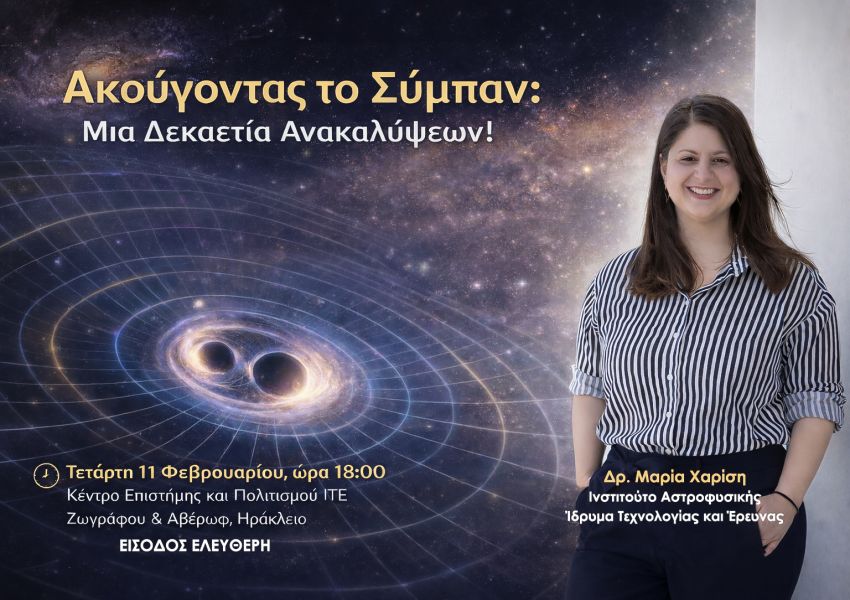
Listening to the Universe: A Decade of Discoveries!
An event organized by the Institute of Astrophysics of FORTH
Imagine two black holes, each 30 times the mass of the Sun but smaller than the city of Heraklion, spinning around each other 15 times per second and creating ripples in spacetime trillions of times thinner than a human hair. This is what astronomers discovered 10 years ago! Such gravitational waves predicted by Einstein over a century ago, open a completely new window onto the universe.
Dr. Maria Charisi, a research fellow at the Institute of Astrophysics of the Foundation for Research and Technology – Hellas (FORTH), will present a decade of discoveries, from colliding black holes and neutron stars to gargantuan mergers of supermassive black holes in galaxy centers—shedding light on the most extreme and violent phenomena in the Universe.
The event entitled “Listening to the Universe: A Decade of Discoveries” is organized by the Institute of Astrophysics of FORTH and will take place on Wednesday, February 11, 2026, at 18:00, at the FORTH Science & Cultural Center. The event is held on the occasion of the International Day of Women and Girls in Science (established by the United Nations in 2015) celebrated annually on February 11th, as well as the 10th anniversary of the publication of the first direct detection of gravitational waves (February 11, 2016).
The speech will be given by Dr. Maria Charisi, a research fellow at the Institute of Astrophysics of FORTH, where she leads a research group funded by the European Research Council (ERC). She is also an Assistant Professor at Washington State University (USA) and a recipient of the 2024 L’Oréal–UNESCO Award For Women in Science.
She obtained her PhD from Columbia University in New York, followed by two postdoctoral fellowships at Caltech and Vanderbilt University. Her research focuses on studying supermassive black hole pairs using “multi-messenger” astronomy, combining gravitational waves and light to understand some of the universe’s most extreme events.
The event will be held in Greek and will conclude with an interactive quiz led by Panagiotis Evangelopoulos, Astronomy Outreach Officer at the Institute of Astrophysics of FORTH.
Free entrance (Limited seating)
Background Information
International Day of Women and Girls in Science
Established by the United Nations in 2015 and celebrated annually on February 11, the day aims to promote full and equal access of women to education and research, particularly in STEM fields—Science, Technology, Engineering, and Mathematics—to eliminate discrimination, break down stereotypes, and encourage young girls to pursue careers in the sciences, where they are traditionally underrepresented.
The First Direct Detection of Gravitational Waves – Confirmation of Einstein’s General Theory of Relativity
The first direct detection of gravitational waves was achieved on September 14, 2015, at the LIGO observatories in Hanford (Washington) and Livingston (Louisiana), and officially announced on February 11, 2016. This historic observation once again confirmed Albert Einstein’s General Theory of Relativity (1915), revealing ripples in spacetime caused by the collision of two black holes that traveled 1.3 billion years before reaching the LIGO detectors.
Two stellar-mass black holes, with masses approximately 36 and 29 times that of the Sun, merged to form a single black hole of 62 solar masses, releasing energy equivalent to about three solar masses, converted into gravitational waves within just 200 milliseconds. The observation was made using Advanced LIGO detectors, employing laser interferometry to measure extraordinarily tiny oscillations—up to 10,000 times smaller than the nucleus of an atom.
This discovery marked the dawn of gravitational-wave astronomy, providing a new way to observe violent and cataclysmic phenomena in the Universe that often emit no electromagnetic radiation and cannot be detected with traditional telescopes.
Important Notice
* * In the context of the General Data Protection Regulation, we would like to inform you that photos and videos will be taken during the event, which will be used to promote the event to the media.