Newsroom

Open Lecture "Drug Trafficking Routes in the Eastern Mediterranean (1900-1950)"
The Lecture will be delivered by Kostis Gkotsinas, Associate Researcher at the Institute for Historical Research of the National Hellenic Research Foundation, and will take place on Wednesday, March 18, (19:30), at the Institute for Mediterranean Studies of FORTH, 130 Nikiforou Foka and Melissinou, in the old down, Rethymnon.
FORTH/ICE-HT participates in the 15th Energy Forum in Patras
The Institute will be represented by its Director, Dr. Theophilos Ioannides, who will deliver a keynote speech titled: “The Role of FORTH/ICE-HT in the Value Chain of New Energy Technologies”

Lecture "Indians and Peoples: Contemporary Challenges, Historical Experiences. A case study: Mexico"
Τhe Institute for Mediterranean Studies (IMS) of the Foundation for Research and Technology-Hellas (FORTH) is organizing a lecture entitled "Indians and Peoples: Contemporary Challenges, Historical Experiences. A case study: Mexico".
The Lecture will take place on Wednesday, February 25, (19:30), at IMS-FORTH, 130 Nikiforou Foka and Melissinou, in the old down, Rethymnon.

Call for Participation in the International Youth Entrepreneurship Competition “EUSAIR POPRI youth”
The Science and Technology Park of Crete (STEP-C) of the Foundation for Research and Technology – Hellas (FORTH) invites secondary school students and university students to participate in an important initiative that promotes youth innovation and entrepreneurship. For the fourth consecutive year, Crete participates in the European initiative “EUSAIR POPRI youth”, in cooperation with the Primorski Tehnološki Park of Slovenia. This initiative is addressed to secondary education students (14–18 years old) from the Region of Crete and to university students (18–29 years old) from academic and research institutions in Crete.

New Director of the Institute for Mediterranean Studies of FORTH
Dr. Marinos Sariyannis, Research Director at the Department of Ottoman History, and deputy Director of the Institute for Mediterranean Studies since 2017, was unanimously elected Director of the Institute on December 3, 2025 (Official Government Gazette: 129_ΥΟΔΔ_10.2.2025).
The election was carried out by a seven-member Evaluation Committee appointed by the Ministry of Development and chaired by Ms. Antonia Kiousopoulou, Emeritus Professor at the Department of History and Archaeology, School of Philosophy, National and Kapodistrian University of Athens (NKUA).

New Director of the Institute of Computer Science of FORTH
Mr. Panagiotis Tsakalides, Professor at the Department of Computer Science of the University of Crete, ex-Deputy Director of the Institute of Computer Science (ICS) of FORTH (19/6/2021-31/8/2025) and ex- Acting Director of the Institute (1/9/2025-23/10/2025), was unanimously elected Director of ICS on 24 October 2025 (Official Government Gazette (FEK): 129_ΥΟΔΔ_10.2.2026).
The election was carried out by a seven-member Evaluation Committee appointed by the Ministry of Development and chaired by Nikolaos Sidiropoulos, Louis T. Rader Professor, and Chair of the Dept. of Electrical & Computer Engineering, University of Virginia.
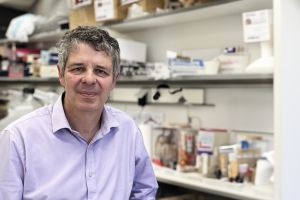
New Director of the Institute of Molecular Biology and Biotechnology of FORTH
Professor Ioannis Vontas was unanimously re-elected Director of the Institute of Molecular Biology and Biotechnology (IMBB) of FORTH, on December 12, 2025. (Official Government Gazette (FEK): 129_ΥΟΔΔ_10.2.2025).
The election was carried out by a seven-member Evaluation Committee, appointed by the Ministry of Development and chaired by Professor Nikolaos Kyrpides, Senior Scientist (Biologist), Lawrence Berkeley National Laboratory, Joint Genome Institute, United States Department of Energy, Walnut Creek, USA.
Prof. Vontas brings extensive experience both at the administrative level—having served as Director of IMBB since 2021—as well as at the scientific level, as the research of his group on the development of biotechnological methods for controlling agricultural pests and insects of public health importance has gained significant international recognition.
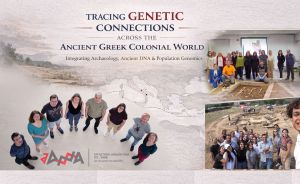
Tracing Genetic Connections Across the Ancient Greek Colonial World
An interdisciplinary team of scientists from the Institute of Molecular Biology and Biotechnology (aDNA Lab IMBB) at the Foundation for Research and Technology – Hellas (FORTH), in collaboration with experts from multiple scientific fields, has shed new light on one of antiquity’s most captivating chapters: Ancient Greek colonization. Their study on “Genetic affinities between the ancient Greek colony of Amvrakia and its metropolis”, published in the leading scientific journal Genome Biology, reveals how human mobility shaped the ancient Greek world beyond material culture.
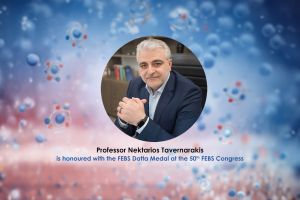
Professor Nektarios Tavernarakis is honoured with the FEBS Datta Medal at the 50th FEBS Congress that will take place in Maastricht, The Netherlands
The FEBS Datta Medal is a prestigious award, bestowed annually by the Federation of European Biochemical Societies to a distinguished senior scientist for outstanding achievements in the fields of Biochemistry and Molecular Biology, or related sciences. It is one of the top three awards given by FEBS at the annual FEBS Congress, and includes a silver medal and funding for accommodation and travel to the Congress.
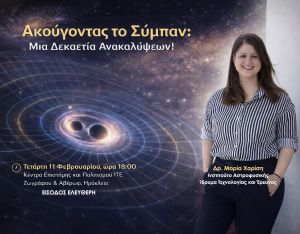
Listening to the Universe: A Decade of Discoveries!
An event organized by the Institute of Astrophysics of FORTH
The event will take place on Wednesday, February 11, 2026, at 18:00, at the FORTH Science & Cultural Center and will be held on the occasion of the International Day of Women and Girls in Science celebrated annually on February 11th, as well as the 10th anniversary of the publication of the first direct detection of gravitational waves. The speech will be given by Dr. Maria Charisi, a research fellow at the Institute of Astrophysics of the Foundation for Research and Technology – Hellas (FORTH), who will present a decade of discoveries, from colliding black holes and neutron stars to gargantuan mergers of supermassive black holes in galaxy centers—shedding light on the most extreme and violent phenomena in the Universe.
Page:123456789 | Next >